Coffee Aroma Vocabulary & Maillard Reaction
Coffee Smell Vocabulary & The Maillard Reaction
#coffee/sensory #coffee/roasting #coffee/theory #note
Smell is the primary driver of coffee flavor perception—over 80% of what we perceive as "taste" is derived from direct (orthonasal) and throat-to-nasal (retronasal) olfaction.
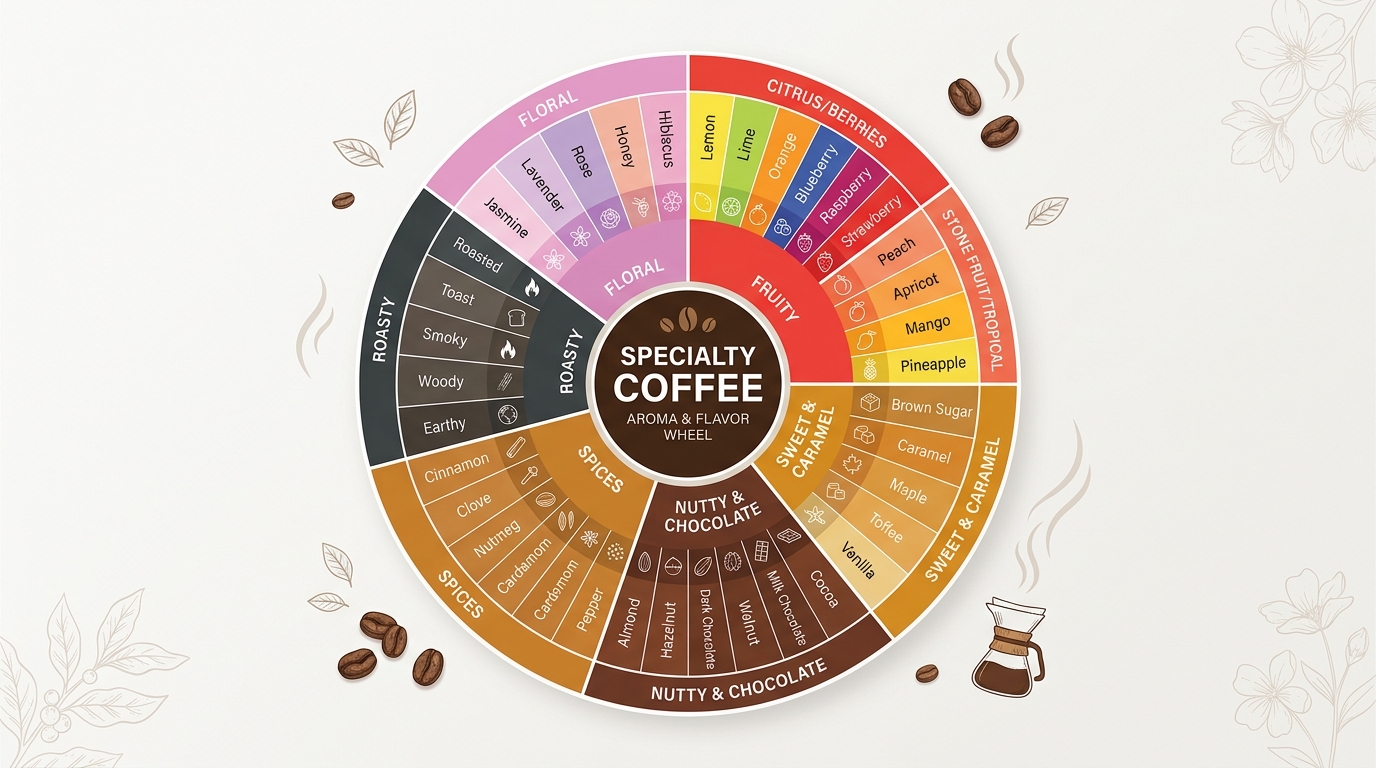
1. The 4 Olfactory Stages in Coffee
- 🌿 Fragrance: The scent of freshly ground, dry coffee beans before hot water is added.
- ♨️ Aroma: The volatile vapors released when hot water saturates the coffee (e.g., breaking the crust in cupping).
- 👅 Nose / Retronasal: Aromatic compounds perceived through the back of the palate and throat while sipping and swallowing.
- ⏳ Aftertaste / Finish: Lingering flavor vapors remaining in the mouth, throat, and breath after swallowing.
2. Color-Coded Aroma Spectrum (SCA & WCR Lexicon)
| Color Tone | Category | Characteristic Descriptors | Roasting & Origin Context |
|---|---|---|---|
| 🌸 Pink / Violet | Floral | Jasmine, chamomile, rose, lavender, coffee blossom, hibiscus | High-altitude washed Geisha, Ethiopian Yirgacheffe (Light Roast) |
| 🔴 Vibrant Red | Fruity (Berry & Citrus) | Strawberry, blueberry, raspberry, lemon, lime, bergamot, orange | Natural & anaerobic fermentations, Kenya, Colombia (Light Roast) |
| 🟡 Golden Amber | Fruity (Stone & Tropical) | Peach, apricot, mango, pineapple, passion fruit, lychee | Process-driven fermentations, Central American cultivars |
| 🍯 Warm Gold | Sweet & Caramelized | Brown sugar, caramel, maple syrup, honey, vanilla, toffee | Light-to-Medium roasts, high sucrose development |
| 🍫 Cocoa Brown | Nutty & Cocoa | Dark chocolate, milk chocolate, roasted hazelnut, almond, cacao nibs | Brazilian, Guatemalan, and classic espresso profiles (Medium Roast) |
| 🌰 Ochre / Cinnamon | Spices | Cinnamon, clove, nutmeg, cardamom, black pepper, ginger | Naturally complex origins or mild darker development |
| 🌾 Beige / Grain | Cereal & Malt | Malt, barley, sweet toast, wheat biscuit | Baseline roast notes, early browning stage |
| 🍃 Sage Green | Vegetal & Herbaceous | Lemongrass, green tea, pea shoots, fresh mint | Very light filter roasts or fresh-crop harvest |
| 🍷 Deep Plum | Fermented & Winey | Red wine, rum, dried prune, raisin, balsamic | Extended maceration, natural process, aged coffees |
| ⬛ Dark Slate | Roasty & Smoky | Cedar wood, pipe tobacco, charred oak, dark malt | Medium-Dark to Dark roast profiles (Pyrolysis products) |
Sensory Defects & Off-Smells
- 🌾 Grassy / Baked / Bready: Under-developed roast or stalled roast heat.
- 🪵 Burlap / Baggy / Musty: Past-crop beans, high humidity storage, or mold.
- 🥜 Peanut Shell / Quaker: Unripe cherries picked prematurely.
- 🧪 Phenolic / Medicinal / Rubbery: Fermentation defects or Rio-zone fungal contamination.
3. The Maillard Reaction in Coffee Roasting
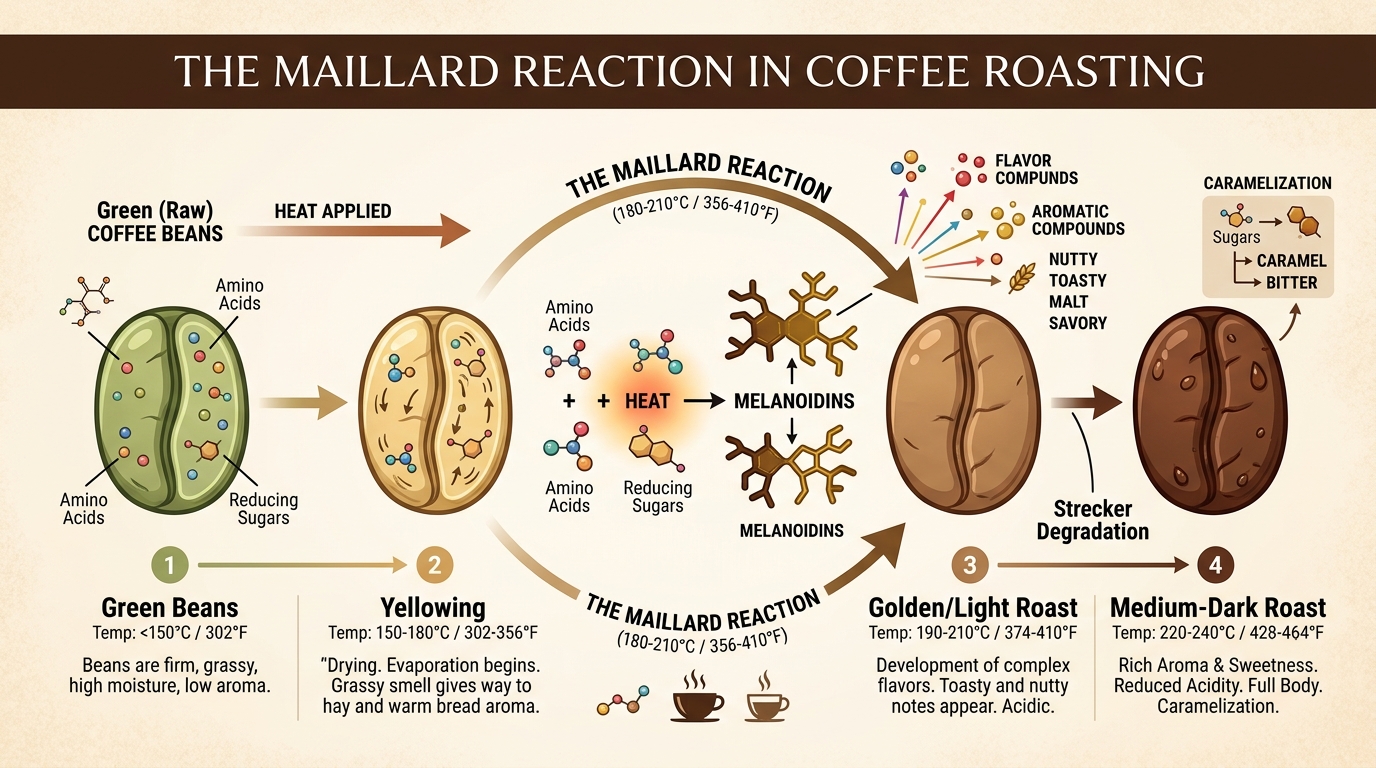
The Maillard Reaction is a non-enzymatic chemical reaction between amino acids (proteins) and reducing sugars (glucose, fructose) when exposed to heat (typically between 150°C and 200°C / 300°F–392°F).
$$\text{Reducing Sugars} + \text{Amino Acids} \xrightarrow{\text{Heat (150°C - 200°C)}} \underbrace{\text{Aroma Volatiles (Pyrazines, Furans)}}{\text{Complexity & Aroma}} + \underbrace{\text{Melanoidins}}{\text{Brown Color & Crema Body}}$$
Key Contributions to the Cup
- Creates Signature Roast Aromas:
- Pyrazines & Pyrroles: Nutty, roasted, toasted bread, and biscuit notes.
- Furans & Furanones: Sweet, caramel, and baked goods aromas.
- Strecker Degradation: Volatile aldehydes producing delicate savory and fruity nuances.
- Generates Melanoidins (Body & Crema): High-molecular-weight brown polymers called melanoidins give coffee its rich brown color, dense mouthfeel, and stable espresso crema.
- Harmonizes Acidity: Softens harsh raw chlorogenic acids into smooth, balanced sweetness.
Roasting Control: Fast vs. Slow Maillard Phase
- Extended Maillard Time (Slower Heat): Builds higher body, rounder mouthfeel, and deeper chocolate/nutty/malty base tones (ideal for espresso blends).
- Short Maillard Time (Faster Heat): Preserves vibrant floral and fruit acids, highlighting delicate origin terroir (ideal for filter coffees).
4. References & Further Reading
- Specialty Coffee Association (SCA) & WCR:
- Science & Roasting:
- Scott Rao — Coffee Roasting: Best Practices
- Le Nez du Café — 36 Aroma Evaluation System
See Also
Local Knowledge Graph